
How much of your invalid traffic did you pay for?
Only the part Google billed and never credited. Google does not bill clicks it filters, and credits some clicks it finds later; in 2007 it put invalid clicks under 10 percent.
On this page (7)
Key takeaways
- Google does not bill clicks it filters as invalid before the month closes, and their cost goes back into the campaign budget.
- Clicks found invalid after billing are credited later where Google finds it appropriate and possible; the Invalid clicks column counts only filtered clicks.
- Google says a third-party tool may flag clicks that Google already filtered and never billed, so a flagged click is not necessarily a billed one.
- For the clicks a tool flags, and if its flags are right, what you paid lies between two readings: all of them billed, or the flagged minus filtered and credited clicks.
Ask how much of a budget went to click fraud, and a quick estimate multiplies ad spend by a detection vendor's rate. The precise term is invalid traffic (IVT): bots, crawlers and accidental clicks as well as deliberate fraud. What an advertiser paid for can be smaller than that product. This guide traces the gap in Google Ads and Microsoft Advertising, as of September 24, 2026.
Google bills only clicks it did not filter
Google does not charge for an interaction it identifies as invalid before the billing cycle ends, according to its help page on invalid traffic. It removes such clicks from billing and from Clicks and Cost, and restores their cost to the campaign budget. The Invalid clicks column, added to the campaigns table under Columns, counts them.
The filter works after the ad has served: Google says filtered traffic can still reach your website, and your analytics might record the visit.
Filtered and credited clicks are separate ledgers
Invalid clicks that Google finds only after the invoice come back in the following billing cycle as an invalid activity credit, "when appropriate and possible", and its help page calls that credit "not directly related" to the Invalid clicks column. Campaign metrics freeze at month end, so a credited click stays in Clicks and Cost; the Invalid Activity Credit Report, offered for Search and Performance Max, lists it under Credited clicks and the money returned under Credited amount. Credits and investigations are covered in does Google refund invalid clicks?
Where each part of invalid traffic shows up in a Google Ads account
| Line in the account | Where to find it | Billed | Part of what you paid |
|---|---|---|---|
| Clicks and Cost | Campaigns table | Yes | Yes, until a later credit |
| Invalid clicks | Campaigns table, under Columns | No, cost restored to the budget | No |
| "Invalid activity" adjustment | Billing, Summary, Adjustments | Yes, then credited | No |
| Credited clicks and Credited amount | Invalid Activity Credit Report | Yes, then credited | No |
| Clicks a third-party tool flags | The tool's report | Not known per click | Only the billed, uncredited part |
Microsoft Advertising keeps a similar split, according to its help on monitoring clicks: it bills only standard-quality clicks and lists low-quality ones in the Low-quality clicks column.
Third-party tools can see clicks Google filtered
Google's help page says third-party tools might flag traffic, such as duplicate IP addresses or bot activity, that Google already filtered and kept off the bill. Google also says it cannot give a click-by-click comparison with a third-party report, so the overlap between a tool's flags and the Invalid clicks column cannot be looked up.
That makes the base of a published rate matter. Lunio's Global Invalid Traffic Report 2026 covers 2.7 billion paid clicks on six ad platforms from August 1, 2024 to July 31, 2025, measured in campaigns run in monitor-only mode, analyzing every site visit with Lunio's own blocking switched off (page 6), and it calls the result the invalid traffic that gets past the platforms' native defenses. What each published rate counts is set out in invalid traffic in numbers 2026.
Since the overlap cannot be looked up, a tool's count for one account and one month, on the same campaigns and dates, gives two readings:
- Strict: every click the tool flagged was billed. Flagged clicks times the average CPC.
- Conservative: every click Google filtered or credited is among the flagged ones. Flagged clicks minus Invalid clicks minus Credited clicks, never below zero, times the average CPC.
If the tool's flags are right, the billed and never credited cost of the flagged clicks lies between the two. Where the Credit Report is offered, subtract its Credited amount instead of Credited clicks times the CPC; where it is not, subtract the campaign's invoice credit. The flagged and filtered clicks are priced at the average CPC, because Google documents no cost for filtered clicks and a tool can only estimate one.
Both readings start from the tool's own count, and Google's filter runs after the ad serves, so a tracking template or a site tag records the click whether Google filters it or not. Lunio's help center says its Invalid Clicks count is sophisticated IVT only, and that it keeps general IVT, such as duplicate clicks and known crawlers or bots, in a category of its own, the class ad platforms "generally do a good job of detecting and excluding". Its guide to refund requests adds that where a Google invoice already carries invalid activity adjustments, "the spend from these is already filtered out from your Lunio data".
The table sets seven click-level tools against three criteria and one limit each, from their own pages as read between September 25 and October 5, 2026: where each sees the click, how it flags one, and whether it can count for a stretch without excluding anything, the way the report above was measured. Google's list of certified click trackers includes the tracking domains of six of them: Lunio, ClickCease, ClickGUARD, ClickPatrol, Fraud Blocker and TrafficGuard.
Where click-level tools see a click, and how they count it
| Tool | Where it sees the click | How a click is flagged | Counts without excluding anything | Limit |
|---|---|---|---|---|
| Lunio | Tracking template on Google Ads and an on-site JavaScript tag | Machine learning scores each click legitimate, suspicious or invalid from click, context and conversion signals; invalid ones broken down by 19 waste types; its Invalid Clicks count is sophisticated IVT only, general IVT shown apart | Google Ads: unprotected, monitor-only campaigns, the mode its 2026 report was measured in; Meta, LinkedIn, Microsoft Ads, DV360: a Monitor status in each setup guide; a 14-day audit across paid search, social and display with no changes to live campaigns | Where a consent banner blocks its site script, visitors who decline are not monitored; Lunio says the script must fire regardless of consent, citing legitimate interest under the GDPR |
| CHEQ | A tag across the whole site | Each paid interaction checked in real time on environment, behavior and network | Not documented | Its free-trial link leads to a demo booking |
| ClickCease (part of CHEQ) | A site tag plus the ad account connection | 2,000+ tests per visit add up to a risk score | Monitoring Only mode, off by default | IP blocking only on campaign types with an IP exclusion list and a landing page, such as Search |
| ClickGUARD | Tracking template, site script or server-side tracking | Site interaction scored as low, medium or high bot probability | Monitoring mode, no automated blocking | Google's cap of 500 IPs per campaign; older blocks are removed to make room |
| ClickPatrol | A tracking template on Google Ads | Machine learning on 800+ data points per click | Monitor Only Mode | Real-time blocking on Google only |
| Fraud Blocker | The site's traffic, analyzed in real time | Score per IP and device; above 7 of 10 counts as invalid | Monitoring Only Mode, which also removes the IPs already sent | Protection stops when the plan's ad-click allowance is used up |
| TrafficGuard | Tracking template required on Google Ads, site tag recommended | Fingerprinting, device profiling, VPN and proxy checks, plus campaign rules | Detection mode | Shield plan: one domain connected to a Google Search Ads account |
The Media Rating Council's list of accredited digital services, read on September 25, 2026, names Google Ads for Search and Display clicks and for filtering sophisticated invalid traffic. DoubleVerify and Integral Ad Science (IAS), which it lists for that filtering, verify impressions in programmatic and social media, a different category from the click-level tools above; both are set against Google's filtering in do ad platforms filter sophisticated invalid traffic?
Expert view
Where this gets awkward is the review meeting a few months on. Heidi Sturrock of OMG Commerce raised it in the Smart Bidding masterclass I hosted: quarterly and year-end reviews where a team has to account for a stretch of data from a broken tag. Her fix was a note on those dates, written while people still know what went wrong.
I'd give credits the same note. Once a credit comes in, the invoice and the campaign report stop agreeing. So I'd write each credit in against the month its clicks came from, keep a tool's estimate on a line of its own, and not add the two up.
Vendor rates split about fourfold across Google inventory
Google's help page gives no invalid traffic rate by campaign type; published rates at that level come from vendors. In Lunio's analysis of 2.7 billion paid clicks from August 2024 to July 2025, Google Search campaigns came to 5.21 percent and Google Video Partners (GVP) to 20.62 percent, against 7.57 percent across Google Ads and 8.51 percent across all six platforms, according to its report.
Fraud Blocker, a click-level detection vendor, publishes averages on a different base on its benchmark page: 104 million clicks in 43,701 Google Ads accounts connected to its platform, over the six months to February 25, 2026, presented as Google's invalid click numbers. Reading them as the Invalid click rate, the share Google filtered before billing, is this guide's inference; the page shows how to add the Invalid Click Rate column but does not say its averages were read from it.
Invalid click rates by Google campaign type and network, on two vendor bases
| Google campaign type or network | Post-click rate, Lunio, 2.7B clicks, Aug 2024 to Jul 2025 | Strict reading per $1M, click share as spend share | Fraud Blocker, 104M clicks in 43,701 accounts, 6 months to Feb 2026 (read as filtered before billing) |
|---|---|---|---|
| Search | 5.21% | $52,100 | 11.2% |
| Performance Max | 7.88% | $78,800 | 12.1% |
| Shopping | 8.46% | $84,600 | 7.9% |
| Demand Gen | 8.45% | $84,500 | 8.1% |
| Display | 12.02% | $120,200 | 35.5% |
| Google Video Partners (Lunio); Video campaigns (Fraud Blocker) | 20.62% | $206,200 | 35.5% |
| All Google Ads | 7.57% | $75,700 | 11.4% |
| All six platforms | 8.51% | $85,100 | Not measured |
The two rate columns come from different advertisers, periods and bases, so neither can be subtracted from the other. Lunio's report describes its rates as the invalid traffic that gets past the platforms' native defenses; Fraud Blocker's averages, if read as the Invalid click rate, count what Google filtered before billing.
A $5M budget, $98,000 apart
Take an illustrative Google budget of $5 million a year: 60 percent Search, 25 percent Performance Max, 10 percent Shopping and 5 percent Display. Weighted by that mix, Lunio's campaign-type rates from its report on 2.7 billion clicks of August 2024 to July 2025 give 0.60 × 5.21 + 0.25 × 7.88 + 0.10 × 8.46 + 0.05 × 12.02 = 6.543 percent.
An illustrative $5M Google budget, read two ways
| Rate applied to $5M | Lunio rate, 2.7B clicks, Aug 2024 to Jul 2025 | Strict reading, click share as spend share |
|---|---|---|
| All six platforms | 8.51% | $425,500 |
| All Google Ads | 7.57% | $378,500 |
| Weighted by campaign type | 6.543% | $327,150 |
For this illustrative mix, the gap of about $98,000 between the first and last row comes only from which level of the same dataset is applied. How loss estimates apply rates to spend is the subject of how much ad spend is lost to invalid traffic.
The conservative reading then needs the account's own columns. A click's credit lands in the month after the click, according to Google's page on the Credit Report, so run the reading once those credits have posted. Where it stays large, the next step is an investigation request through the Click Quality Form, which Google limits to activity from the past 60 days, according to its help page, and part of that window has gone by then.
In 2007, Google put invalid clicks under 10 percent
Google's help page gives no network-wide rate and says there is no industry standard for a normal one. The network-wide figures from Google found for this guide come from its Inside AdWords team, in a post of March 1, 2007 introducing an update from Shuman Ghosemajumder, then Business Product Manager for Trust & Safety.
Google said in that post that its invalid click rate, which it called the activity metric, had stayed below 10 percent of all clicks in every quarter since AdWords launched in 2002. Clicks found invalid only after an advertiser reported them came to less than 0.02 percent of all clicks in every quarter since the 2002 launch, fewer than 2 in 10,000, according to the same post. It gave no separate figure for the middle stage, offline analysis whose finds became adjustments on the bill, as credits do today.
That rate included clicks removed as a matter of policy, such as the second click of every double click. And Google wrote that the network figures say nothing about an individual advertiser, pointing to each account's own invalid clicks report.
Frequently asked questions
Does Google charge for clicks in the Invalid clicks column?
- No. It counts clicks Google filtered before the billing cycle closed, and their cost goes back to the campaign budget.
Can a third-party tool count clicks Google already filtered?
- Google says it can: a third-party tool may flag traffic that Google filtered and never billed, and a filtered visit can still reach the site. Lunio's help center says its Invalid Clicks count covers sophisticated IVT only and keeps general IVT, which it says ad platforms generally detect and exclude, in a category of its own.
How do I estimate what I paid for invalid clicks in one account?
- Take the clicks a tool flagged for one month on the same campaigns. The strict reading counts all of them as billed. The conservative reading first subtracts the Invalid clicks and the credited clicks, never going below zero. Multiply both by the average CPC. If the tool's flags are right, the billed, uncredited cost of those clicks lies between the two.
Which invalid traffic rate should I apply to Google Search spend?
- One measured on the same campaign type and the same base. In Lunio's analysis of 2.7 billion paid clicks from August 2024 to July 2025, Google Search campaigns came to 5.21 percent, against 7.57 percent across Google Ads and 8.51 percent across six platforms, so an all-platform rate applied to Search spend gives a higher figure. Fraud Blocker's averages on 104 million Google Ads clicks over the six months to February 2026 also put Search, at 11.2 percent, below its 11.4 percent for all campaign types.
Does Microsoft Advertising bill low-quality clicks?
- Not in the end. Microsoft says it bills only standard-quality clicks; if a billed click is later found low-quality or invalid, the bill is adjusted and the click stays listed as standard-quality in the reports.
Has Google published an invalid click rate for its whole network?
- In a blog post of March 1, 2007, Google said the clicks it marked invalid had stayed below 10 percent of all clicks in every quarter since 2002, and those found only after advertiser reports below 0.02 percent. Its current help page gives no network rate.
Sources
- Google Ads Help: About the Invalid Activity Credit Report (answer 16826168), support.google.comAccessed
- Microsoft Advertising Help: Monitoring clicks, telling the good from the bad (updated 2026-06-19), learn.microsoft.comAccessed
- Fraud Blocker: Invalid Click Rate, Averages and Benchmarks for Google Ads (updated September 18, 2026), fraudblocker.comAccessed
- Google Inside AdWords blog: Invalid Clicks, Google's Overall Numbers (March 1, 2007), adwords.googleblog.com
- ClickPatrol: Google Ads page, on the tracking template and real-time blocking, clickpatrol.comAccessed
- Fraud Blocker Help: Can I pause my subscription? November 16, 2025, on Monitoring Only Mode, fraudblocker.comAccessed
- Lunio Help Center: installing the multiplatform tracking script, on consent, July 16, 2026, help.lunio.aiAccessed
- Lunio Help Center: how to set up Bing (Microsoft Ads) with Lunio, on the Monitor status, help.lunio.aiAccessed
- Lunio Help Center: How to set up Meta with Lunio, on the Monitor status, September 2, 2026, help.lunio.aiAccessed
- Lunio Help Center: How to set up DV360 with Lunio, on the Monitor status, September 2, 2026, help.lunio.aiAccessed
- Google Ads Help: List of certified Google click trackers (answer 13707634), support.google.comAccessed
- Lunio Help Center: Waste Analysis, understanding your invalid traffic breakdown, help.lunio.aiAccessed
More articles
All guides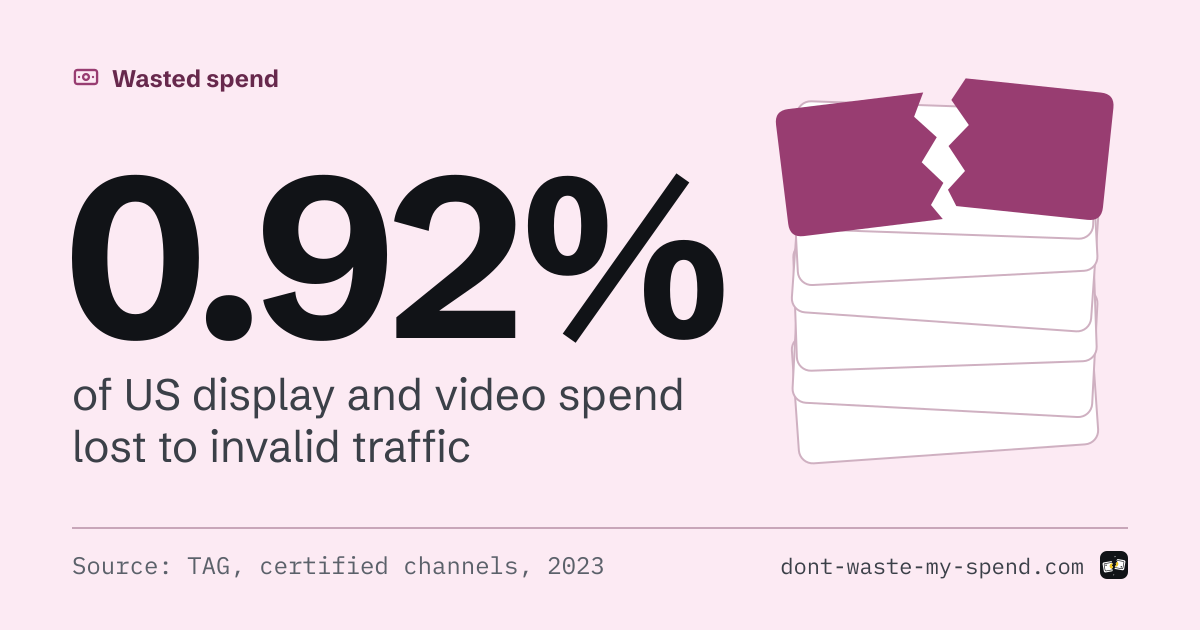
How much ad spend is lost to invalid traffic?
Vendor estimates of global losses in 2025 run from $32.6 billion to $165 billion. TAG puts 2023 losses in certified US display and video channels at 0.92 percent of spend.
10 min read
What affiliate networks check before a commission locks
Networks screen partner traffic; the brand has to decline bad orders before the lock, by default 27 days after month end on impact.com. After payment, the contract decides.
9 min read
Do ad platforms filter sophisticated invalid traffic?
On Google and Microsoft search clicks, yes, and it is audited. Social clicks are audited for the basic kind at most, which makes up about 80 percent of what Google filters.
11 min read