
Do ad platforms filter sophisticated invalid traffic?
On Google and Microsoft search clicks, yes, and it is audited. Social clicks are audited for the basic kind at most, which makes up about 80 percent of what Google filters.
On this page (8)
Key takeaways
- Invalid traffic comes in two classes: the general kind (GIVT), caught with lists of known bots and data centers, and the sophisticated kind (SIVT), which takes deeper analysis to find.
- The Media Rating Council (MRC), which accredits ad measurement, accredits filtering of the sophisticated kind on Google and Microsoft search clicks, of the list-based kind only on LinkedIn, Pinterest and Snap clicks, and no Meta click metric at all.
- Google estimates that about 80 percent of the invalid clicks it filters are the list-based kind, and its Invalid clicks column shows both kinds as one number.
- Google's accreditation letter of March 31, 2026 names only Search campaign clicks; Display, Demand Gen, Performance Max and Shopping clicks are not named.
For search clicks on Google and Microsoft, yes, and an auditor has checked it. Invalid traffic (IVT) comes in a basic, list-based class and a sophisticated one. The Media Rating Council (MRC), which accredits ad measurement in the US, accredits Google and Microsoft search clicks and Amazon Sponsored Products clicks with filtering for both. LinkedIn, Pinterest and Snap clicks are accredited for the basic class only, and Meta has no accredited click metric.
Lists catch GIVT, analysis catches SIVT
Both classes come from an MRC document, the Invalid Traffic Detection and Filtration Standards Addendum, first released in October 2015 and updated in June 2020, still current together with an interim update from April 2024. General invalid traffic (GIVT) is what routine checks against lists and standard parameters find. Sophisticated invalid traffic (SIVT) needs advanced analytics, corroboration across several signals or significant human review.
Every accredited measurer must filter GIVT. SIVT filtering is strongly encouraged and required only in cases the addendum names. It is also the part that can be accredited on its own, and each letter names the provisions it covers.
How the MRC addendum classes each kind of traffic
| Traffic | Class in the MRC addendum |
|---|---|
| Known invalid data-center traffic | GIVT |
| Known bots, spiders and crawlers | GIVT |
| Non-browser user agents | GIVT |
| Pre-fetched or pre-rendered pages | GIVT |
| Sessions that cannot render an ad | GIVT |
| Bots posing as people | SIVT |
| Infected or hijacked devices | SIVT |
| Click farms and other organized human activity | SIVT |
| Tricked or accidental clicks, clickjacking | SIVT |
| Hidden or stacked ads | SIVT |
| Duplicates removed as processing or timing artifacts | Not IVT |
Click farms count as SIVT because the addendum treats organized human activity as incentivized invalid activity. Accidental clicks depend on the cause. The MRC files tricking users into clicking under SIVT, Google's help page on invalid traffic lists clicks on poorly placed ads without naming a class, and Google's credit report page counts accidental or duplicate clicks as invalid traffic.
Lists have edges too. For data-center traffic, the addendum requires at minimum the IPs of Amazon AWS, Google and Microsoft, and notes that the TAG Data Center IP list leaves out mixed data-center IPs, where people browse as well.
Google's column adds both classes together
In Google Ads, the Invalid clicks column shows clicks filtered before billing, both classes in one number. Google's Description of Methodology explains why the two classes are not reported apart: separate totals would let someone reverse engineer the data. By the same page's estimate, GIVT makes up about 80 percent of the invalid click traffic Google filters, with no period or base given.
The Google Ads API exposes half the split anyway. Its field metrics.general_invalid_clicks is the subset found by routine filtration, so invalid clicks minus that field leaves the SIVT part. Google says its GIVT click metrics are submitted to the MRC and not yet accredited. The API also defines the Invalid click rate as filtered clicks over filtered plus unfiltered clicks.
Google's decision rate, the share of traffic with enough data for an IVT decision, is 100 percent, "based on the reviewed sampled data". Google filters after the fact and blocks up front only in some cases, historically less than 2 percent of ad requests.
Google's help page adds that no industry-wide standard exists for a normal invalid traffic rate; the published rates are collected in Invalid traffic in numbers 2026. Clicks found invalid after billing return as credits, shown for Search and Performance Max in the Invalid Activity Credit Report and covered in Does Google refund invalid clicks?
Microsoft Advertising shows the split. Its help page points to the Low-quality clicks columns, and its reporting columns split them into general and sophisticated low-quality clicks, neither of them charged.
Lunio, one of the click-level tools in the table further down, keeps the two apart in its own dashboard: its help center says an Invalid Click there is SIVT only, and GIVT sits in a category of its own.
Search and Amazon clicks hold SIVT accreditation
Accreditation means an auditor has checked the measurement against the standard, for the metrics, environments and classes a letter names. From the MRC's list of accredited digital services, on September 24, 2026:
Click metrics each platform holds MRC accreditation for
| Platform | Accredited click metric | Class audited | Letter | Named exclusions |
|---|---|---|---|---|
| Google Ads | Search campaign clicks | GIVT and SIVT | March 31, 2026 | Video and App clicks, Dynamic Search Ads and AI Max (Google's page) |
| Microsoft Advertising | Paid search clicks, desktop and mobile web | GIVT and SIVT | January 31, 2025 | In-app and Audience Network not named |
| Amazon Sponsored Products | Display and search clicks | GIVT and SIVT | July 8, 2026 | Totals only, no environment split; Amazon placements only |
| Sponsored Content, Text and Dynamic Ads clicks | GIVT only | May 28, 2026 | Audience Network | |
| Pin clicks | GIVT only | January 20, 2026 | Outbound clicks | |
| Snap | Swipe ups, in-app | GIVT only | July 29, 2026 | None named |
| Meta | None | SIVT, for impressions and video plays | October 2, 2026 | No click metric |
| TikTok | No entry of its own | None | None | Points to a TAG certification |
Of the eight platforms in the table, only Google, Microsoft and Amazon hold click accreditation inclusive of SIVT.
Verification vendors hold third-party SIVT accreditation
For the case where a measurer applies only GIVT detection, the addendum encourages buyers to consider adding SIVT detection through a third party or another method. Third-party tools come in two categories with different jobs: click-level IVT detection scores ad clicks and writes exclusions into search and social ad accounts, and programmatic verification checks impressions and bid requests. The table sets both against Google's own filtering on four criteria, from the vendors' own pages and the MRC's list as read between September 25 and October 5, 2026: what each checks, how it acts, whether the MRC lists it for SIVT, and its limit. Rows are grouped by category: the click-level tools, then Google's own filtering, then the verification vendors.
Click-level tools, Google's own filtering and verification vendors
| Tool | Category | What it checks | How it acts | On the MRC list for SIVT | Limit |
|---|---|---|---|---|---|
| Lunio | Click-level IVT detection | Each click, scored legitimate, suspicious or invalid; its Invalid Clicks count is SIVT only, GIVT reported apart | Google: IP exclusion lists and an excluded audience; Meta, LinkedIn, Microsoft, DV360, Taboola: excluded audiences of invalid users; an invalid IP found on one platform is excluded on the others | Not listed | Classifies clicks, not views or impressions, though its exclusions keep flagged users out of view-based campaigns too; limited app-install coverage |
| CHEQ | Click-level IVT detection | Each paid interaction, through a site-wide tag | Blocks through Google Ads and Meta API integrations | Not listed | CTV and in-app coverage not documented |
| ClickCease (part of CHEQ) | Click-level IVT detection | Each visit, through a site tag and the ad account connection | Google: IP and audience exclusions; Meta, Microsoft: exclusion audiences | Not listed | Meta: only ads that send users to the site |
| Fraud Blocker | Click-level IVT detection | Each IP and device fingerprint, scored out of 10 | Google: IP exclusion list; Meta: excluded custom audience | Not listed | Microsoft: scored, but no automatic blocking since October 2024 |
| TrafficGuard | Click-level IVT detection | Clicks and app installs; fingerprinting, device and proxy checks; its security page says detection is built to MRC guidelines | Google: IP exclusion list; Meta: audience excluded for 14 days | Not listed | Meta: website conversion campaigns only |
| Google Ads (built in) | Ad platform | Clicks, impressions and conversions | Removes invalid traffic from bill and reports; credits what it finds after billing, when possible | Search clicks per the 2026 letter; the list also names Display | Runs after the ad serves; cannot block traffic from the site |
| DoubleVerify (DV) | Programmatic verification | Display and video impressions on web, app and CTV | Pre-bid avoidance, post-bid blocking; social integrations | SIVT and pre-bid IVT: desktop, mobile web, app, CTV | Search clicks and IP exclusions not documented |
| HUMAN Security | Programmatic verification | Programmatic traffic pre-bid and post-bid; site visits | Pre-bid filtering; redirects invalid site visits to non-revenue pages | SIVT and pre-bid IVT: desktop, mobile web, app, CTV | Google Ads and social platform actions not documented |
| Integral Ad Science (IAS) | Programmatic verification | Ads on desktop, mobile, CTV and social | Blocks before the impression is served; IVT reporting on social | SIVT: desktop, mobile web, app, CTV; pre-bid IVT without CTV | Search clicks and IP exclusions not documented |
None of the click-level tools in the table is on the MRC's list, and the pages of the three verification vendors describe no action inside Google Ads, such as IP exclusions. Their accreditation has a scope as well. On the MRC's list, the reporting of YouTube data by DoubleVerify and by Integral Ad Science (IAS) is accredited for rendered and viewable video only, with no IVT metric, and DoubleVerify's Facebook reporting for rendered and viewable Newsfeed impressions, also without one. DoubleVerify's TikTok viewability reporting in the app does include SIVT filtration.
Google's help page on invalid traffic adds that third-party tools might flag traffic as invalid that Google has already filtered and excluded from the bill, so a tool's count and Google's Invalid clicks column can overlap.
Social clicks accredited for GIVT at most
LinkedIn's accreditation excludes its Audience Network. Pinterest's covers Pin clicks and excludes outbound clicks, the ones that leave Pinterest for the advertiser's site. Snap's covers swipe ups, its click metric, in the app only. All three are audited for GIVT only.
Meta's letter covers impressions, video plays and 2-second continuous video plays on Facebook and Instagram, net of SIVT, and no clicks. Meta does detect invalid clicks: its help page names clicks from fake accounts, bots, scrapers and browser add-ons as invalid and says advertisers are not charged for them. That click filter sits outside Meta's accredited scope.
TikTok has no MRC entry of its own. Its help page points to its TAG Certified Against Fraud certification, says its IVT solution is powered by Protected by Mediaocean, a vendor the MRC accredits for SIVT, and names partnerships with DoubleVerify and IAS.
A GIVT-only letter says nothing either way about SIVT filtering.
Expert view
A GIVT-only letter reads to me as a floor. When I wrote about the platform rates in January, LinkedIn was the clearest case: it removes fake accounts at registration, but the more sophisticated automation reaches the ads before detection kicks in. A GIVT audit doesn't test for that at all.
Search on Google and Microsoft is better documented, and I'd give them that. It doesn't change what I concluded in that piece, though, that every platform filters some of it and none catches all of it.
Google's 2026 letter names only Search clicks
The letter of March 10, 2025 named clicks on Search campaigns and on Display campaigns in Gmail, YouTube and the Google Display Network. The letter of March 31, 2026 names only Search campaigns for clicks. The MRC's summary page and Google's methodology page still list Display clicks. The letter is what the accreditation rests on, so the strict reading is Search only, and the other two pages give the wider one. What each ad platform documents about invalid traffic sets this letter beside the platforms' help pages and dates how they changed.
Google is also moving Display campaigns into Demand Gen, with a migration tool rolling out from June 2026, and its methodology page says Demand Gen Display was submitted for accreditation as of the second quarter of 2025.
Google campaign types in the MRC click accreditation
| Campaign type | Clicks in Google's MRC accreditation |
|---|---|
| Search | Named in 2025 and 2026, inclusive of SIVT |
| Display | Named in 2025, not in 2026; still on the summary pages |
| Demand Gen | Clicks not named; video metrics accredited for skippable in-stream only |
| Performance Max | Not named in either letter |
| Shopping | Not named in either letter |
| Video and App | Excluded by Google's methodology page |
Not named means outside the audited scope, and nothing more: Google says it filters both classes across clicks and video impressions. Inside Search, Google's methodology page says Dynamic Search Ads and AI Max "aren't a part of the MRC accreditation process for Search campaign Clicks", and clicks from connected TVs and unknown device types are not accredited but may sit in the totals; Google estimates them at less than 1 percent of search click traffic.
Accreditation stops before the lead form
Every accreditation above ends at the click or the impression. Google's help page says its filters run after the ad serves and cannot keep traffic from reaching the site and its lead forms, and its methodology page calls it unlikely that all invalid traffic can be identified in advance. The MRC, for its part, does not consider it appropriate to label filtered traffic as "human".
No platform's own MRC click accreditation with SIVT covers these:
- Meta and TikTok clicks, and LinkedIn, Pinterest and Snap clicks beyond GIVT.
- Google Display, Demand Gen, Performance Max and Shopping clicks on the strict reading, and Video and App clicks.
- Microsoft Audience Network and in-app placements.
- Lead forms and offline conversions on any platform. Whether bot conversions reach bidding is the question the guide Does Google remove bot conversions before Smart Bidding learns from them? answers.
For any third-party tool, the same two questions apply: SIVT or not, and for which metrics and environments.
Frequently asked questions
What is the difference between GIVT and SIVT?
- GIVT is invalid traffic that routine checks against lists and standard parameters find. SIVT takes advanced analytics, corroboration or human review, and includes bots posing as people, hijacked devices, click farms and clickjacking. Accredited measurers must filter GIVT; SIVT filtering is strongly encouraged.
Does Google filter sophisticated invalid traffic?
- Yes. Google says it filters both classes, and the MRC accredits its SIVT filtration for clicks on Search campaigns. By Google's own estimate, about 80 percent of the invalid clicks it filters are GIVT.
Does the Invalid clicks column show GIVT and SIVT separately?
- No. The column in the Google Ads interface shows both classes as one number. The Google Ads API has a separate field for general invalid clicks, so the difference gives the SIVT part. Microsoft Advertising reports general and sophisticated low-quality clicks in separate columns.
Are Meta ad clicks accredited by the MRC?
- No. Meta's accreditation, in the MRC letter of October 2, 2026, covers impressions, video plays and 2-second continuous video plays, net of SIVT. Meta says it does not charge for invalid clicks, but that click filter is outside the audited scope.
Are Performance Max and Demand Gen clicks covered by Google's accreditation?
- Not by name. Google's letter of March 31, 2026 names only Search campaign clicks. Demand Gen is accredited for video metrics on skippable in-stream ads, and Performance Max appears in neither the 2025 nor the 2026 letter. Google's methodology page also says Dynamic Search Ads and AI Max are not part of the accreditation process for Search campaign clicks. Google still says it filters invalid traffic across clicks.
What does Google's 100 percent decision rate mean?
- It is the share of traffic with enough data for Google to decide whether it is invalid, based on reviewed sampled data. It says nothing about how much invalid traffic was found or missed.
Sources
- MRC: Invalid Traffic Detection and Filtration Standards Addendum, June 2020 Update (Final), mediaratingcouncil.org
- MRC: 2024 IVT Interim Updates (published April 24, 2024), mediaratingcouncil.org
- Google Ads Help: Google Display Ads campaigns have a new home in Demand Gen, support.google.comAccessed
- MRC: Google Ads accreditation letter, March 31, 2026, mediaratingcouncil.org
- MRC: Accredited services, Digital (retrieved 2026-09-24, vendor entries 2026-09-25), mediaratingcouncil.org
- MRC: Microsoft Advertising accreditation letter, January 31, 2025, mediaratingcouncil.org
- MRC: Amazon Sponsored Products accreditation letter, July 8, 2026, mediaratingcouncil.org
- MRC: LinkedIn accreditation letter, May 28, 2026, mediaratingcouncil.org
- MRC: Pinterest accreditation letter, January 20, 2026, mediaratingcouncil.org
- MRC: Snap accreditation letter, July 29, 2026, mediaratingcouncil.org
- MRC: Facebook and Instagram Ads accreditation letter, October 2, 2026, mediaratingcouncil.org
- Microsoft Advertising Help: Monitoring clicks, telling the good from the bad (updated 2026-06-19), learn.microsoft.comAccessed
- Microsoft Advertising Reporting API: CampaignPerformanceReportColumn value set, learn.microsoft.comAccessed
- ClickCease Help Center: Everything about ClickCease Meta (Facebook) Ads protection, support.clickcease.comAccessed
- TrafficGuard Help: How to connect your Google Ads account to TrafficGuard, help.trafficguard.aiAccessed
More articles
All guides
Do widely quoted ad fraud statistics hold up?
None of 10 widely repeated invalid traffic figures holds as quoted. Four are quoted for more than they count, and three are credited to a source that does not carry them.
12 min read
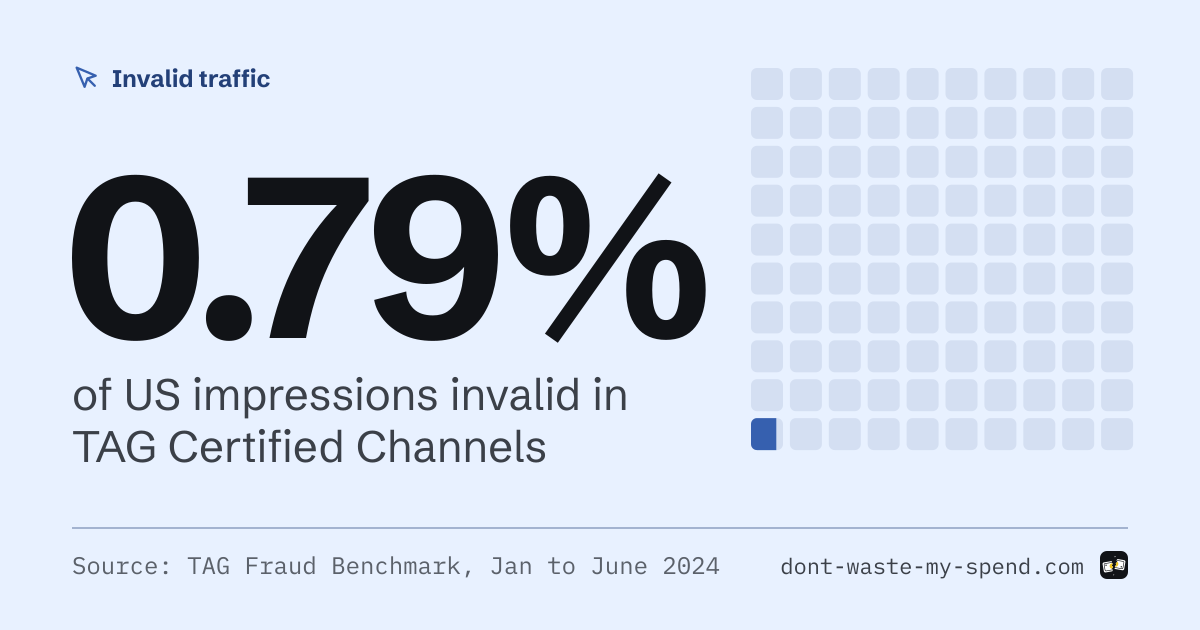
Invalid traffic in numbers 2026
Published invalid traffic rates run from under 1 percent to 41 percent. Most of the spread is method: impressions or clicks, protected buying or unprotected.
10 min read
Do Search partners and video partners bring more invalid clicks?
Yes. In over 550 million ecommerce clicks in Q4 2025, Google filtered 10.3 percent on Search partners as invalid, twice its Search rate. Vendors rank video partners highest.
13 min read